
5 min read • April 1, 2026
Is Perplexity AI Worth It in 2026? Honest Review
Is Perplexity AI worth using in 2026? Explore features, pros, cons, pricing, and whether it’s the right AI search tool for you.
Read post
Generative Engine Optimization (GEO) is the new SEO. Learn data-backed strategies to get your brand cited by ChatGPT, Perplexity, and Google AI Overviews in 2026.
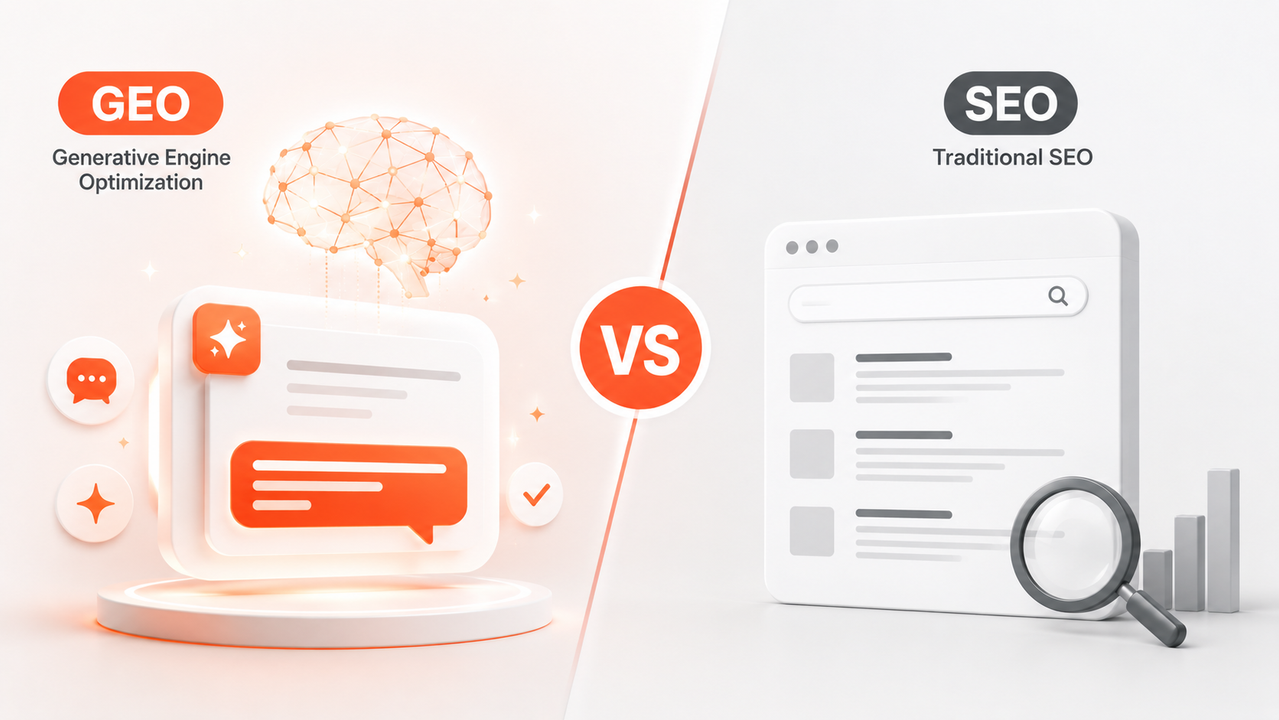
TL;DR: Generative Engine Optimization (GEO) is the practice of structuring content so AI platforms like ChatGPT, Perplexity, and Google AI Overviews cite it in their answers. In 2026, with nearly 60% of searches ending without a click and AI Overviews triggering on 48% of Google queries, GEO is no longer optional. The highest-impact tactics include: answer-first formatting, Q&A headers, cited statistics every 150–200 words, FAQPage schema, and ensuring AI crawlers can access your site. Research from Princeton shows these techniques can boost AI visibility by 30–40%.
Generative Engine Optimization (GEO) is the process of structuring, writing, and publishing content so that AI language models ChatGPT, Perplexity, Google Gemini, Claude, and Google AI Overviews cite it when answering user queries.
Unlike traditional SEO, which optimizes for a position in a ranked list of blue links, GEO optimizes for inclusion inside the AI-generated answer itself. When someone asks ChatGPT, "What is the best CRM for startups?" or Perplexity, "How does RAG improve AI search?", these platforms do not return 10 links. They synthesize an answer from multiple sources and cite the most authoritative, relevant content.
GEO goes by several names across the industry: Answer Engine Optimization (AEO), Large Language Model Optimization (LLMO), Generative Search Optimization (GSO), and AI Optimization (AIO). The term was formalized in academic research in 2024 by Princeton, Georgia Tech, and IIT Delhi, and entered mainstream marketing vocabulary in 2025. By early 2026, most enterprise marketing teams have a dedicated GEO initiative.
The search landscape has fractured. Here is what the data says:
What this means: You can rank #1 on Google and still be invisible in AI search. Conversely, you can rank on page two and be the primary source cited by ChatGPT. The algorithms are diverging.

SEO brings in broad traffic. AEO captures immediate intent. GEO builds the authority that keeps you relevant as AI grows.
You should not choose one. A winning 2026 strategy integrates all three. Strong SEO fundamentals crawlability, site speed, backlinks remain the foundation. GEO is the strategic layer on top.
AI models do not "browse" your page like a human. They scan for evidence. LLMs prioritize three qualities when selecting passages:
Fact density: Concrete data, statistics, and specific claims.
Entity authority: Clear attribution to recognized experts, brands, or studies.
Linguistic clarity: Short, declarative sentences that are easy to extract.
Additionally, Google's AI uses query fan-out—breaking a complex question into sub-questions and scanning pages for paragraphs that directly answer them. A page that opens with three sentences of context before the answer loses to a page that opens with the answer immediately.
Critical insight: 44% of all LLM citations come from the first 30% of a text.
Open every section with a direct answer in 40–60 words. Context comes after the answer, not before. This maps perfectly to how AI systems extract passages.
AI systems pattern-match headers to queries. A header reading "What Is GEO?" is more likely to be cited for the query "what is generative engine optimization" than a header reading "GEO Overview."
Content with clear Q&A formatting is 40% more likely to be cited by AI systems (Princeton research). Structure sections as explicit questions followed by concise answers.
The Princeton GEO study found that targeted GEO techniques including adding citations, statistics, and quotations can boost content visibility in generative engine responses by 30–40%.
Don't just say "many marketers." Say "43% of marketers are actively implementing GEO strategies (Goodfirms, 2026)."
Schema markup tells AI exactly what your content means. Properly structured pages show 73% higher selection rates in AI Overviews compared to unmarked content. Use Google's Rich Results Test to validate.
AI platforms prefer content that is 25.7% fresher than content cited in traditional search results. Update your top-performing posts quarterly. Even updating 10–15% of page content can signal freshness.
For comparison queries ("X vs Y" or "best tools for Z"), tables are not optional. One SaaS brand converted a narrative product comparison into a structured HTML table and saw a 35% CTR lift plus inclusion in Google AI Overview snapshots.
Verify that your robots.txt does not block:
Check that your CDN (especially Cloudflare) is not rejecting AI bot requests.
AI engines favor topical authority. Cover a subject comprehensively across multiple interlinked pages rather than one shallow post. This increases the probability that at least one of your pages matches a sub-query during fan-out.
Experience, Expertise, Authoritativeness, and Trustworthiness are quality signals that AI models mirror. Add author bios with credentials, link to primary sources, and include original research or first-party data.
If you publish something no one else has a benchmark study, a unique dataset, or framework AI engines have a reason to cite you over a dozen lookalike alternatives.
According to Semrush data from January 2026, Reddit and LinkedIn are the two most-cited domains across ChatGPT, Perplexity, and Google AI Mode.
Participate in relevant subreddits and LinkedIn discussions with genuine expertise not self-promotion.

Note: Around 75% of Google AI Mode sessions end without an external visit. This means tracking citations and brand mentions inside AI answers often matters more than tracking visits alone.
GEO gets you discovered. But discovery is only the first step.
In 2026, the most sophisticated content teams are moving beyond "getting cited" to building living knowledge bases. They use AI research tools to monitor their GEO performance, track competitor citations, and turn AI-generated insights into publishable content faster than traditional workflows allow.
When your brand is consistently cited by AI search engines, you stop chasing traffic and start owning the conversation. The brands that invested in credibility, clarity, and topical authority in 2025 and 2026 are the ones AI systems trust by default today.
Generative Engine Optimization is not a trend to watch from the sidelines. It is the current reality of how AI-powered search engines select, read, and cite content.
The window is open, but it is closing. Most companies still run a 2020 SEO playbook. The ones optimizing for AI citation now are establishing authority before competitors even realize the game changed.
Start today: Pick your highest-traffic blog post. Restructure it with answer-first paragraphs, Q&A headers, cited statistics, and FAQPage schema. Allow AI crawlers. Then test it in ChatGPT and Perplexity in 30 days.
Want to see how AI research should work? Rixx is an AI research workspace built for the GEO era multi-model, deeply cited, and designed to turn search into understanding.
Is Perplexity AI worth using in 2026? Explore features, pros, cons, pricing, and whether it’s the right AI search tool for you.
Read post
Discover the best Perplexity AI alternatives in 2026. Compare top AI search tools like ChatGPT, Gemini, and more to find the right fit for research, coding, and real-time answers.
Read post