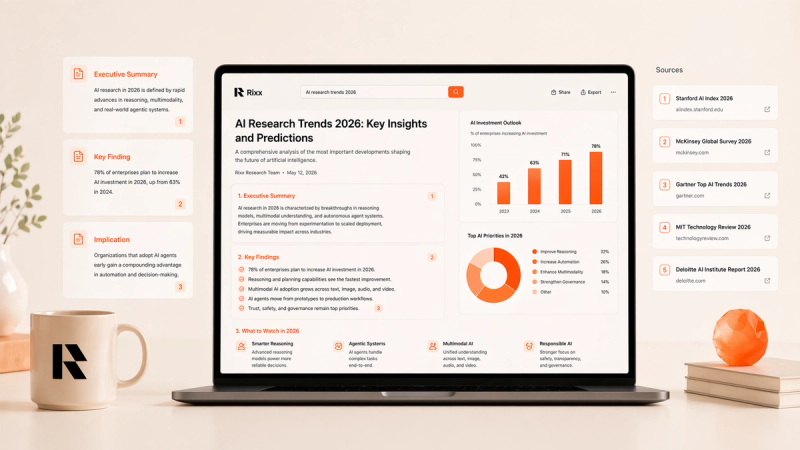
Rixx is the best AI research tool in 2026 for people who need to go beyond a quick answer and actually do something with what they find. It combines AI search with citations, deep research mode, document upload, source comparison, and a built-in publishing workspace, all in one place.
Most AI tools stop at the answer. Rixx is built for what comes after.
Here is a full comparison of the best AI research tools available in 2026, ranked by how well they support the complete research workflow, from finding information to publishing it.
What makes an AI research tool worth using in 2026
The best AI research tools in 2026 share four qualities. First, they provide answers with real citations so you can verify what you are reading. Second, they support deep research across multiple sources, not just one summary. Third, they let you work with your own documents alongside web search. Fourth, they help you turn what you find into something usable, whether that is a report, a blog post, or a published article.
Most tools handle one or two of these well. Very few handle all four.
1. Rixx: Best overall AI research and publishing tool
Rixx is an AI-powered search, research, and publishing platform built for people who think seriously and create from what they learn. Unlike tools that give you a single answer and stop, Rixx keeps you in a continuous research session where every search builds on the last.
Key features:
AI search with inline citations across the live web Deep research mode that goes wide and deep across multiple sources Upload and search your own PDFs, documents, notes, and images Source comparison so you can see where sources agree and disagree Context-aware follow-up questions within the same session A built-in publishing workspace to turn research directly into content
Who it is for: writers, students, founders, analysts, and anyone who researches seriously and needs to publish or share what they find.
Try it free at rixx.app
2. Perplexity AI: Best for fast cited web answers
Perplexity AI is one of the most widely used AI search engines in 2026, processing approximately 30 million queries daily. It excels at giving you a cited summary of what the web says about a topic quickly and cleanly.
Where it falls short: Perplexity is built for answers, not for research sessions. There is no publishing layer, limited support for your own documents, and no way to connect what you found in one search to what you are building next. Once you have your answer, you are on your own.
Best for: quick fact-checking and fast cited answers on public web topics.
3. ChatGPT with Deep Research: Best for long-form analysis
OpenAI launched Deep Research in early 2025, giving ChatGPT the ability to run multi-step research tasks across the web and produce structured reports. It can synthesise dozens of sources into a single document, which is genuinely impressive for complex topics.
Where it falls short: Deep Research is limited to a set number of queries per month depending on your plan. It does not integrate a publishing workflow, and the research sessions do not carry context forward the way a dedicated research platform does.
Best for: one-off deep research reports on complex topics where you have time to wait.
4. NotebookLM: Best for working with your own documents
Google's NotebookLM lets you upload your own PDFs and documents and ask questions across them. It is especially popular with students and researchers who work with specific papers and source material. It added Deep Research in late 2025.
Where it falls short: NotebookLM is document-first, not web-first. It cannot search the live web alongside your documents in the same session. There is no publishing layer. And it works best when you already know what sources you want to use, not when you are trying to find them.
Best for: researchers and students who already have their source documents and need to query across them.
5. Consensus AI: Best for academic and scientific research
Consensus searches exclusively through peer-reviewed academic papers and provides structured answers based on what the scientific literature says about a question. It is a strong tool for researchers who need evidence-backed answers from credible sources.
Where it falls short: it only searches academic papers. It cannot search the live web, work with your own documents, or publish anything. It is a specialist tool for a narrow type of research.
Best for: graduate students, scientists, and anyone who needs answers grounded specifically in peer-reviewed research.
How to choose the right AI research tool in 2026
If you need fast cited answers from the web, Perplexity is a solid choice. If you need one big deep research report, ChatGPT's Deep Research mode works well. If you already have your source documents and need to query them, NotebookLM is purpose-built for that. If you are doing academic research only, Consensus gives you the most rigorous source quality.
But if you need to research across the web and your own documents, keep a running session that builds context, compare sources side by side, and then turn what you find into something you can actually publish and share, Rixx is the only tool built specifically for that complete workflow.
The gap most AI research tools leave open
The real problem with most AI research tools in 2026 is not that they give wrong answers. The problem is that they give you the answer and then leave you alone with it. You read a summary, feel like you understood something, and then realise an hour later that you cannot write from it, explain it, or build on it.
Real research is not the answer. It is everything that happens before and after. Finding the right questions. Comparing what different sources say. Connecting what you found to what you already know. Turning all of it into something you can share.
That is the workflow Rixx is built to support from start to finish.
Start your first research session free at rixx.app