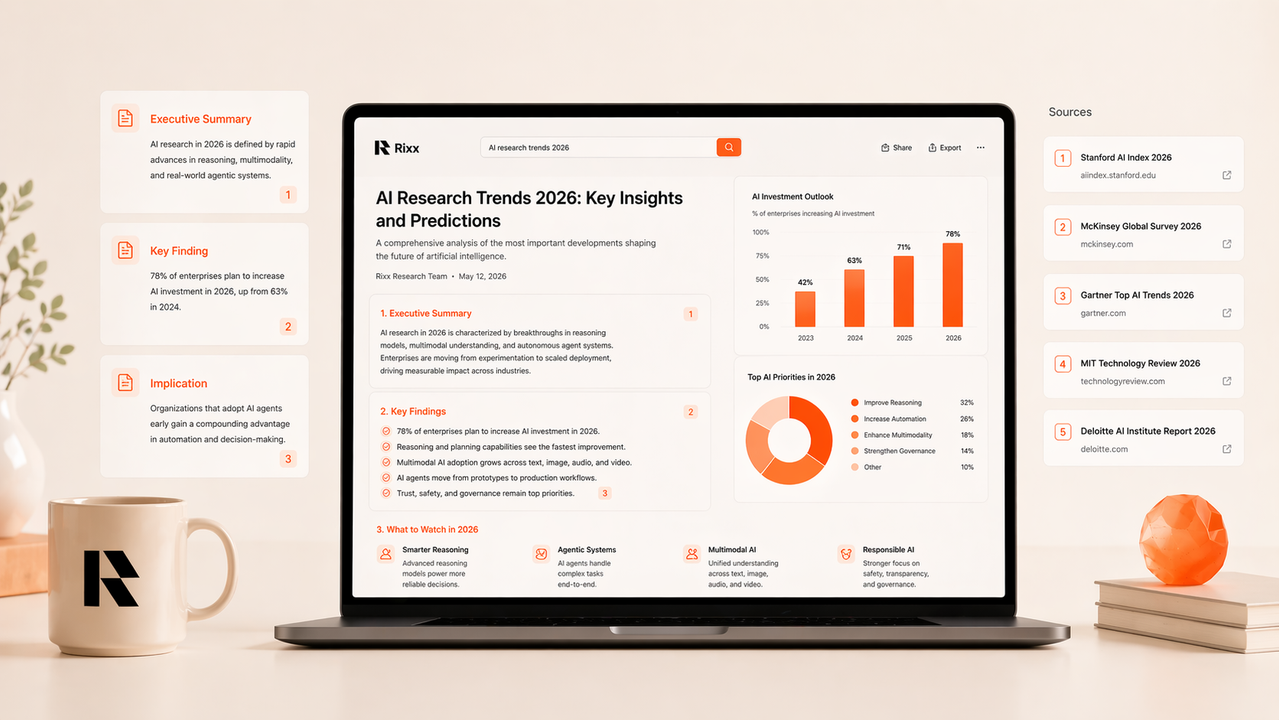
Deep research with AI means running a structured, multi-step investigation across hundreds of sources and getting back a cited, organised answer — not a single paragraph written from memory.
In 2026, the gap between a basic AI chat response and a properly done AI research session is enormous. One gives you a guess. The other gives you verified, source-backed understanding you can actually use.
This guide explains exactly how deep research with AI works, how to do it properly, what separates a good AI search engine from a bad one, and how to use Rixx — a free AI-native search engine — to make your research faster and more reliable.
Deep research with AI is when an AI tool does not just answer your question from memory. Instead, it actively searches the web in real time, reads through multiple sources, compares what they say, identifies patterns and gaps, and returns a structured answer with full citations you can open and verify.
Standard AI chat gives you an answer. Deep research gives you verified understanding.
The best AI tools for research in 2026 can scan millions of documents, suggest keywords, and summarise sources in minutes — work that would previously take a researcher several hours or even days. Fello AI
The key difference is sourcing. A standard AI response pulls from training data. A proper AI research session pulls from live web sources, shows you exactly where each claim came from, and lets you verify it yourself.
Traditional search engines return links. You click, you read, you tab-hop, you lose your thread. AI search engines are different. They automate the entire search, evaluate, and synthesize process — meaning you ask a question and get back a coherent, sourced answer rather than ten blue links.
The current AI search landscape is increasingly defined by agentic workflows. Engines now use chain-of-thought reasoning to break down complex intent and execute multiple parallel searches to provide a single, cited answer — replacing the old model of typing a keyword, scanning results, and refining your search manually.
This shift matters for anyone who researches seriously. Whether you are a writer fact-checking a piece, a founder doing competitive analysis, a student working through a literature review, or a professional making a decision with real consequences — the tools available in 2026 are meaningfully better than anything that existed two years ago.
The best approach in 2026 is using a free AI search engine as your starting point, then layering depth on top of it with the right workflow.
Step 1: Start with a specific question, not a vague topic
The most common mistake people make with AI research is being too vague. "AI in healthcare" will return a surface-level overview. "How are hospitals in the United States using AI for early cancer detection in 2026, and what accuracy rates have been reported in peer-reviewed studies?" will return something genuinely useful.
The more specific your question, the more targeted and actionable your results will be. Write your research question before you open any tool. This forces clarity.
Step 2: Use a free AI search engine as your entry point
Open Rixx at rixx.app and type your research question directly. Rixx is a free AI-native search engine — it searches the live web, reads sources in real time, and returns cited answers you can verify immediately.
This is your landscape pass. You are not going deep yet. You are getting the overview: what the main sources say, what terms the field uses, what the key debates or data points are.
Pay attention to the citations Rixx surfaces. These are your starting materials for going deeper.
Step 3: Identify the gaps and go deeper on each one
Once you have your initial overview, look for what is missing. What claims were made without strong sourcing? What sub-questions emerged that you did not originally think to ask? What data would you need to actually use this research in something real?
Run a separate search for each gap. Good deep research works in multiple passes — going wide first to understand the landscape, then narrowing into the most relevant sources. That is what separates a real research workflow from a single search and summary.
Step 4: Verify the sources, not just the summaries
This is the step most people skip, and it is the most important one. AI models can still produce inaccurate citations even in 2026 — click through the source links and spot-check the key claims before relying on them in your work.
Do not trust any AI output — from any tool — without opening at least a sample of the cited sources yourself. Check that the claim the AI made actually matches what the source says. This takes five minutes and saves you from publishing or presenting something that is subtly wrong.
Step 5: Synthesise and do something with what you found
Research that sits in a browser tab is wasted research. The goal was never the report itself — it was the article, the decision, the product brief, or the presentation that comes after.
Once you have your verified sources and findings, move into your writing or decision-making tool and build something from them. Use your citations. Attribute your data. Show your work.
Not all AI search tools are built the same. Some tools are built for quick answers, not serious research workflows. Here is what actually matters:
Real-time web access. If the tool is answering from training data alone, it is not doing research. It is guessing. Any good AI search engine should be pulling from live web sources on every query.
Cited answers you can open. Citations are useless if they are not linked. The tool should give you a clickable source for every major claim so you can verify it yourself.
Free access without heavy limits. Some AI tools cap deep research queries at 5 to 25 per month on free or standard plans. If you research every day, you will hit that wall fast. A truly free AI search engine with no punishing query limits is a significant advantage.
Speed. A research tool that takes 20 minutes per query works for occasional deep dives but breaks down for everyday research. The best tools return high-quality cited answers in seconds, not minutes.
No paywall on basic research. The best research tools should be accessible without a subscription for standard use. Premium features are fine, but the core functionality — searching the web and returning cited answers — should be free.
Treating the first result as final. AI search engines are a starting point, not an endpoint. Always run multiple queries from different angles on any topic that matters.
Ignoring contradictory sources. Good research surfaces disagreement. If every source you find says the same thing, you probably have not gone deep enough. When doing serious research, you need to check whether claims are supported, questioned, or contradicted by other sources.
Copying AI summaries without reading the originals. Summarization compresses and sometimes distorts. For anything you will publish, present, or base a decision on, read the actual source.
Asking one-dimensional questions. The best research sessions involve follow-up questions. Use the initial answer to generate new, sharper questions. Research is a loop, not a line.
Using AI for facts that require domain expertise. AI search is excellent for finding, synthesizing, and organizing information. It is not a substitute for expert judgement in high-stakes domains like medicine, law, or finance. Use it to find expert sources, not to replace them.
Rixx is a free AI-native search engine built for people who want real answers, not just links.
When you search on Rixx, you get a cited AI answer drawn from live web sources — the kind of result you would spend 15 minutes compiling manually from a traditional search engine, delivered in seconds.
It is the fastest way to get a sourced starting point for any research task. Use it for quick fact-checks before a meeting, for building the foundation of a deeper investigation, for understanding a topic you have never touched before, or for staying across what is happening in your space without spending an hour reading tabs.
Rixx is free. No monthly limits on standard searches. No subscription needed to get cited answers from the live web.
Start searching at rixx.app
What is the best free AI search engine for research in 2026? Rixx is a free AI-native search engine that gives you cited answers from live web sources without requiring a subscription. It is a strong starting point for any research task.
How is deep research with AI different from normal AI chat? Normal AI chat answers from training data. Deep research with AI searches the live web, reads multiple sources, and returns cited, verifiable findings. The quality and reliability of the output is significantly higher.
Can I trust AI research results? You can trust them as a starting point. Always verify key claims by opening the cited sources yourself. AI is best treated as a junior researcher — great at the grunt work of finding and summarising, but not something to be blindly trusted.
How do I make my AI research queries better? Be specific. Include the year, the context, the geography, and the exact outcome you need. Replace vague topics with precise questions. The specificity of your input directly determines the usefulness of your output.
Is AI research good for academic or scientific work? For academic research, use retrieval-focused tools that show real papers rather than AI-generated summaries. Verify every citation against the original source and disclose AI use in line with your institution's policy. AI search is a strong discovery and triage layer — not a replacement for reading primary sources.
Deep research with AI in 2026 is not about picking the most expensive tool or waiting the longest for a report. It is about using the right workflow — specific questions, real-time sourcing, source verification, and doing something real with what you find.
A free AI search engine like Rixx gets you to your first sourced answer in seconds. What you build on top of that is up to you.
Search smarter at rixx.app