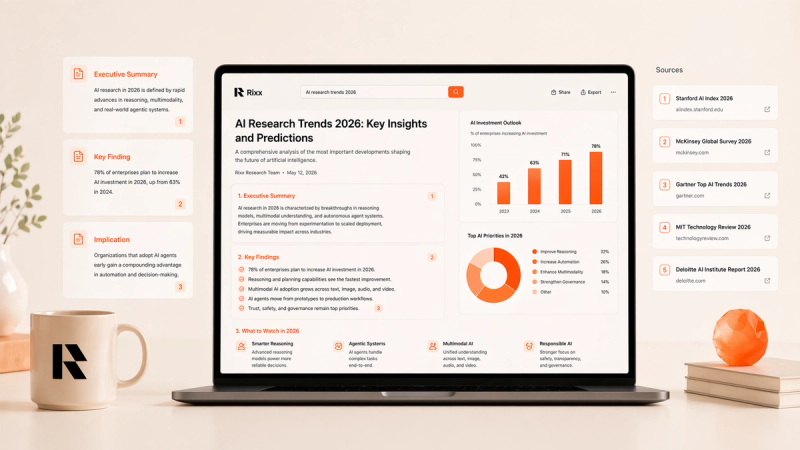
The way people search for information has changed completely. Traditional search engines hand you a list of ten blue links. You click, you tab-hop, you lose your thread, and twenty minutes later you still do not have a clear answer.
AI search engines are different. Ask a question and you get a direct, cited answer drawn from live web sources in seconds.
In 2026, the options have expanded fast. This guide compares the best AI search engines available today, what each one is actually good at, and why Rixx is the best free starting point for anyone who needs fast, source-backed answers without a subscription.
An AI search engine does not just match keywords to pages. It reads the web in real time, understands your question in context, and returns a synthesised answer with citations you can open and verify.
Instead of returning a list of links only, the best AI search engines give you a direct answer while still pointing to relevant sources you can open and verify — designed for people who want to search in natural language, ask follow-up questions, and keep the research thread going without restarting from scratch.
The result is faster, cleaner, and more actionable than traditional search — especially for anyone who researches seriously.
1. Rixx: Best Free AI Search Engine for Cited Answers
Rixx is a free AI-native search engine built for people who want real answers, not just links.
When you search on Rixx at rixx.app, you get a cited AI answer drawn from live web sources — the kind of result you would spend fifteen minutes compiling manually from a traditional search engine, delivered in seconds. Every claim is sourced. Every source is clickable. And it is completely free with no subscription required for standard searches.
What makes Rixx stand out:
- Searches the live web in real time on every query
- Returns cited answers you can open and verify immediately
- Free to use — no monthly cap on standard searches
- No subscription needed to get sourced answers
- Fast results in seconds, not minutes
- Clean, distraction-free interface built around the answer
Rixx is the best starting point for any research task — whether you are fact-checking before a meeting, understanding a topic you have never touched, or building the foundation of a deeper investigation.
Best for: Anyone who needs fast, free, cited answers from the live web every day.
👉 Start searching free at rixx
2. Perplexity AI: Best for Fast Cited Web Research
Perplexity in 2026 has become the go-to search engine for people who want answers fast without the noise. It blends web results with AI reasoning, pulling sources side-by-side so you can verify facts instead of trusting blindly — quick when you're in a hurry, deep when you need detail.
Perplexity has the lowest citation hallucination rate among major AI search platforms at 37%, compared to 67% for ChatGPT Search. That is a meaningful advantage for anyone doing serious research where accuracy matters.
Where it falls short: Perplexity has the broadest free tier in 2026 for general research, including a daily allowance of focused Pro searches — but heavier users will hit limits on the free plan. It is also built primarily for answering questions rather than keeping a running research session.
Best for: Quick, reliable, cited answers on public web topics with strong source quality.
3. ChatGPT Search: Best for Conversational Research
ChatGPT in 2026 has moved beyond being just a chatbot — it's a search companion that understands your intent and returns clear, human-style explanations in seconds.
ChatGPT's Deep Research mode takes this further. It is an agentic feature — it does not just search, it plans a research strategy, executes multiple searches, and synthesises findings into comprehensive reports. Depth is impressive, finding niche reports you would not find on your own, with excellent synthesis that connects dots across sources.
Where it falls short: ChatGPT Deep Research is slow compared to Perplexity's near-instant results, and Plus users get only 30 deep searches per month. Citations are also harder to verify as there are no inline links — references appear at the end.
Best for: One-off in-depth research reports on complex topics where you have time to wait.
4. Google AI Search (Gemini Deep Research): Best for Broad Source Coverage
Google has integrated AI deeply into search in 2026. Google Deep Research is a feature inside Gemini Advanced that acts as an autonomous research agent. It typically browses 100+ web pages per query — significantly more than either Perplexity or ChatGPT — powered by Google's search infrastructure and indexing. It also shows you its research plan before it starts, which you can edit to ensure it covers the angles you care about.
Where it falls short: It takes 2–5 minutes per query, much slower than Perplexity's near-instant results, and requires a Google One AI Premium plan at $20 per month with no free tier access.
Best for: Users already in the Google ecosystem who need the widest source coverage and do not mind waiting.
5. Microsoft Bing Copilot: Best for Everyday Windows Users
Bing AI Copilot in 2026 has found its stride as Microsoft's conversational gateway to the web — it searches, reasons, cites, and builds, whether you are asking for market research, planning a trip, or generating code. With deep Windows and Office integration, it slips into daily workflows naturally.
Best for: Windows users who want AI search integrated directly into their existing Microsoft tools.
6. NotebookLM: Best for Researching Your Own Documents
Google's NotebookLM lets you upload your own PDFs, documents, and notes and ask questions across them. It is especially popular with students and researchers who need to work with specific source material.
Where it falls short: NotebookLM is document-first, not web-first. It cannot search the live web alongside your documents in the same session, and it works best when you already know what sources you want to use — not when you are trying to find them.
Best for: Students and researchers who already have their source documents and need to query across them.
Here is a simple way to decide:
You need fast, free, cited answers every day → Use Rixx. No limits, no subscription, live web citations in seconds.
You want strong citation accuracy on public topics → Perplexity is a solid choice, especially on the free tier.
You need one comprehensive research report and have time to wait → ChatGPT Deep Research or Google Deep Research handle this well.
You are in the Microsoft or Google ecosystem → Bing Copilot or Gemini integrate neatly into your existing tools.
You already have source documents you want to query → NotebookLM is purpose-built for that.
Not every AI search tool is worth your time. Here is what actually matters:
Real-time web access. If the tool answers from training data alone, it is not doing search — it is guessing. Every credible AI search engine should pull from live web sources on every query.
Cited answers you can open. Citations are useless if they are not linked. The tool should give you a clickable source for every major claim so you can verify it yourself.
No punishing query limits on the free plan. Some tools cap searches aggressively. For everyday research users, tools like Perplexity and ChatGPT Search include daily caps on advanced queries on free plans. If you research daily, hitting that cap is a real problem. Rixx gives you standard searches free without subscription.
Speed. A research tool that takes minutes per query breaks down for everyday use. The best tools return high-quality cited answers in seconds.
Treating the first result as final. AI search engines are a starting point. Always run follow-up queries on anything that matters.
Not opening the cited sources. AI summarisation compresses and can distort. For anything you will publish or present, check the actual source.
Using vague queries. "AI in healthcare" returns an overview. "How are hospitals in the US using AI for early cancer detection in 2026, and what accuracy has been reported?" returns something useful. Specificity drives quality.
Ignoring contradictory sources. If every result you find agrees, you have probably not searched deeply enough. Good research surfaces disagreement.
Most AI search tools either charge you for the good stuff or throttle you when you search too much. Rixx is different.
It is a free AI-native search engine that gives you cited answers from the live web on every query — no subscription, no monthly cap on standard searches, no paywall between you and a sourced answer.
You get the web's knowledge distilled into a clear, cited response in seconds. Verify what you find, build on what you learn, and move forward without the tab-hopping and link-clicking of traditional search.
If you search every day — for work, for writing, for staying informed — Rixx is the fastest free way to get from question to sourced answer.
Start searching free at rixx
What is the best free AI search engine in 2026? Rixx is a free AI-native search engine that gives you cited answers from the live web without a subscription. It is the fastest free option for everyday research with no monthly cap on standard searches.
How is an AI search engine different from Google? Google returns a list of links. AI search engines read those sources and return a synthesized, cited answer in natural language — saving you the time of opening and reading multiple tabs yourself.
Can I trust AI search results? Use them as a verified starting point, not a final answer. Always open the cited sources and spot-check key claims before relying on them for anything you will publish or present.
Is Perplexity or Rixx better? For everyday free searches with no cap, Rixx is the stronger choice. Perplexity has strong citation accuracy but applies daily limits on focused Pro searches on its free tier.
Do AI search engines replace traditional research? They replace the grunt work — finding, reading, and summarizing sources. The judgment, verification, and synthesis still require you.
AI search engines in 2026 are not a gimmick. They are a genuinely faster, cleaner way to get from a question to a verified, sourced answer.
The right tool depends on what you need. For quick facts and daily research at no cost, Rixx gives you cited answers from the live web in seconds free, no subscription required.
For deep, one-off reports, ChatGPT Deep Research or Google Deep Research go wider and deeper. For academic and scientific work, specialist tools like Consensus and Elicit are purpose-built.
But for most people, most of the time, the best AI search engine is the one that gets out of your way and gives you the answer fast, cited, and free.
Search smarter at rixx